
Tag Archives: china

Americans and Chinese share jokes on ‘alternative TikTok’ as US ban looms

Thousands of TikTok users have migrated to popular Chinese social media app RedNote

A looming TikTok ban has connected Chinese and American citizens like never before, as they swap jokes and memes in what one user described as a “historic moment”.

It’s all unfolding on a popular Chinese social media app called RedNote, or Xiaohongshu (literally translates as Little Red Book), which doesn’t have the usual internet firewall that separates China from the rest of the world.

It has been drawing self-professed US “TikTok refugees” seeking a new home on the internet – despite the fact that their own government is seeking a TikTok ban because of national security concerns.

Americans now find themselves in direct contact with 300 million Mandarin speakers in China and elsewhere – while in the real world, Beijing is bracing for a tumultuous Trump presidency that could strain its fragile ties with Washington.

‘We’re here to spite our government’

At the heart of the US ban is the fear that China is using TikTok to spy on Americans.

The app has faced accusations that user data is ending up in the hands of the Chinese government – because of a Beijing law that requires local companies to “support, assist and cooperate with the state intelligence work”. TikTok denies this has ever happened, or that it would happen.

But the possibility doesn’t seem to worry some US users – 700,000 new users have signed on to RedNote in the last two days, making it the most downloaded free app in the US App store.

“The reason that our government is telling us that they are banning TikTok is because they’re insisting that it’s owned by you guys, the Chinese people, government, whatever,” said one new RedNote user, Definitelynotchippy.

She goes on to explain why she is on RedNote: “A lot of us are smarter than that though so we decided to piss off our government and download an actual Chinese app. We call that trolling, so in short we’re here to spite our government and to learn about China and hang out with you guys.”

TikTok, although owned by Chinese company ByteDance, is headquartered in Singapore and says it is run independently. In fact, China’s version of TikTok is another app called Douyin. RedNote, on the other hand, is a Chinese company based in Shanghai and among the few social media apps available both in China and outside.

So Washington’s fears over TikTok would extend to RedNote as well.

That’s why American users on RedNote are referring to themselves as “Chinese spies” – continuing a TikTok trend where people have been bidding farewell to their “personal Chinese spy” who has allegedly been surveilling them over the years.

RedNote is now full of posts where ex-TikTok users are in search of a replacement. One post says: “I’m looking for my Chinese spy. I miss you. Please help me find him.”

And Chinese users have answered: “I’m here!”
Who is China sending to Trump’s inauguration?

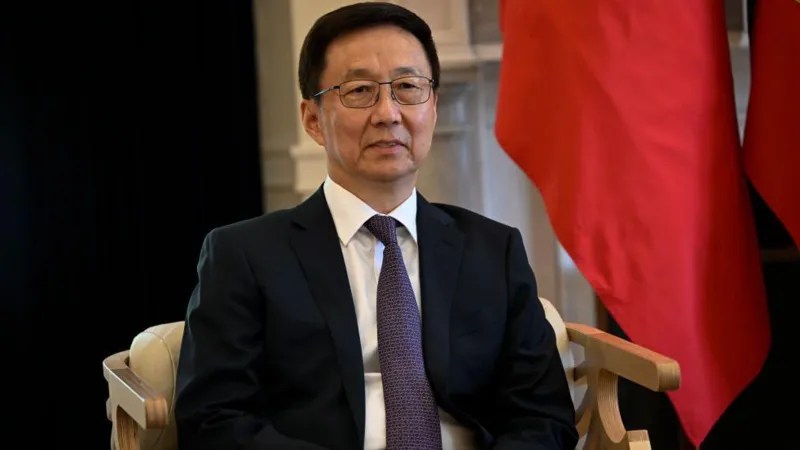
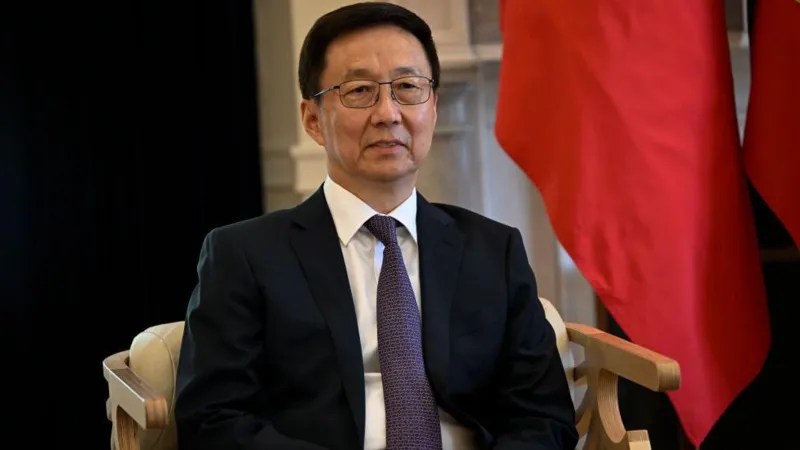
China is sending Vice-President Han Zheng to US President-elect Donald Trump’s inauguration on Monday – the first time a senior Chinese leader will witness a US president being sworn in.

Trump had invited Chinese President Xi Jinping, among other leaders – a break with tradition given foreign leaders traditionally do not attend US presidential inaugurations.

China has said it wants to work with the new US government to “find the right way for the two countries to get along with each other in the new era”.

But Beijing is also preparing for a Trump presidency that is expected to include new tariffs on Chinese-made imports and more combative rhetoric – Marco Rubio, the nominee for Secretary of State, has described China as “the largest, most advanced adversary America has ever faced”.

Three reasons Trump tariffs aren’t China’s only problem

Who are the men who rule China now?

As president, Xi has never attended an inauguration or coronation ceremony, choosing instead to send a representative on his behalf. The Chinese ambassador to the US attended the last two presidential inaugurations, in 2017 and 2021.

Beijing has sent vice-presidents to such ceremonies elsewhere, though – Han attended Indonesian President Prabowo Subianto’s inauguration in October 2023. And his predecessor, Wang Qishan, was present for the inauguration of Philippine President Ferdinand Marcos Jr in 2022 and Brazil’s President Lula da Silva in 2023.

Xi’s decision to send Han to the US is a sign that he “wants to get Trump into deal-making mode, but [he] does not want to be a supporting actor in the Trump show on January 20,” says Neil Thomas, a fellow in Chinese politics at the Asia Society Policy Institute.

Other foreign leaders that have been invited to the inauguration include Argentinian President Javier Milei and Italian Prime Minister Giorgia Meloni.

Trump’s spokesperson Karoline Leavitt told US media that the invitation to Xi was an “example of Trump creating an open dialogue with leaders of countries that are not just our allies but our adversaries and our competitors”.

It also could be an attempt by Trump to show the world “he has the ability to influence Xi’s decision-making and they have a special relationship”, says Yun Sun, the director of the China program at the Stimson Center in Washington.

Earlier reports suggested that some Trump advisers wanted Cai Qi to attend. Widely seen as Xi’s right-hand man, 66-year-old Cai sits on the Communist Party’s seven-man Politburo Standing Committee, China’s equivalent of a cabinet.

The Financial Times quoted an unnamed insider saying that Trump would be “unhappy” if the Chinese envoy in attendance was “only at the level of Han or [Foreign Minister] Wang Yi”. The BBC has been unable to verify these claims.

But as vice-president, 70-year-old Han occupies a “very senior role in the Chinese state system” and the decision to send him “accords courtesy to Trump”, says Chong Ja-Ian, a non-resident scholar at Carnegie China.

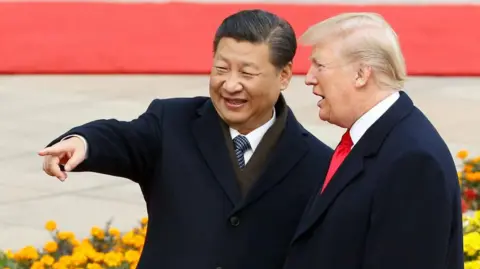
Getty Images Chinese President Xi Jinping is smiling and pointing at something while talking to US President Donald Trump at a welcoming ceremony in November 9, 2017 in Beijing, China.
Xi Jinping and Donald Trump in Beijing in November 2017

Han, who was appointed vice-president in March 2023, is known as “number eight” – the most senior leader after the seven men in the Politburo Standing Committee.

Han too had been a member until October 2022, when Xi began a historic third term in power and appointed his most trusted deputies to the top jobs.

Prior to that Han spent most of his political career in Shanghai, where he was born. In 2007, he served as Xi’s aide when the latter was the party secretary in Shanghai, before later assuming the post himself in 2012.

Foreign affairs has been a key focus for him in his stint as vice-president. He led a group to promote the Belt and Road initiative – a key Chinese trade and infrastructure project – and headed a steering committee on the 2022 Winter Olympics in Beijing.

But the fact that Han no longer sits on the Politburo Standing Committee may have been a key consideration in Beijing’s decision to send him.

“Should US-China relations take a turn for the worse from the party’s perspective, Xi and the party will be able to show that they maintained some distance from Trump,” Prof Chong said.

And it also helps that Han is not considered a part of Xi’s inner circle, according to Mr Thomas.

“Xi trusts Han enough to undertake this mission but Han is not a key ally and could be safely blamed if it goes embarrassingly wrong.”